How much cash to bring to Bali for 1 week?
Bali Villa Hub
2/21/2026
How much cash to bring to Bali for 1 week?
Planning cash for a week in Bali helps you relax and enjoy the island without constant card worries. Small vendors, local warungs, taxis and many market stalls prefer cash, while hotels and larger activities often accept cards. This guide gives practical cash amounts, sample budgets, the best mix of payment methods and safety tips so you can choose what suits your trip.
Recommended cash to carry for a 7-day Bali trip
Deciding how much physical cash to bring makes your week in Bali smooth and relaxed. Most places accept cards for higher-value items, but small vendors, taxis and local warungs prefer cash. Bring enough in IDR (Indonesian rupiah) to cover daily essentials and a few extras; convert approximate values to USD (US dollars) if that helps you plan.
Frugal budget for a simple week
Carry IDR (Indonesian rupiah) 1,500,000 in cash, which is about USD (US dollars) 100. This amount covers local meals, scooter fuel and short rides as long as accommodation and major activities are prepaid with a card or bank transfer.
Comfortable mid range budget
Bring IDR (Indonesian rupiah) 3,500,000 in cash, which is about USD (US dollars) 230. This allows for mid-range restaurants, a couple of private drivers, short day tours, entrance fees and small shopping purchases while still using cards for larger bills.
Higher cash amount for activities and shopping
If you plan on spa treatments, beach clubs, private drivers or markets, plan to carry IDR (Indonesian rupiah) 6,000,000 in cash, which is about USD (US dollars) 390. Carrying this level of cash means you can pay instantly for uncarded experiences without relying on ATMs each day.
Practical tips include carrying a mix of denominations with several 100,000 and 50,000 notes plus some 20,000 and 10,000 notes for small purchases and tips. Store most cash securely in a hotel safe and keep only what you need for the day in a money belt or a zip pocket. With these clear amounts you can choose the level that fits your plans and travel style and enjoy Bali without constant cash worries. Next, compare these amounts with sample one-week budgets to see which matches your trip.
Typical costs and sample one-week budgets
Below are concrete one-week budgets that reflect real costs on the island. Each plan lists total cash needs and what that amount typically covers so you can match spending choices to your travel style.
Prices are shown in IDR (Indonesian rupiah) with an approximate USD (US dollars) equivalent to give clear guidance. These numbers assume accommodation varies from budget guesthouses to comfortable private villas and that major payments can be made by card where available.
- Budget plan total IDR (Indonesian rupiah) 2,500,000 about USD (US dollars) 160. This covers a dorm or budget guesthouse, street food and local warungs, scooter rental for a week and low-cost sightseeing with minimal paid tours.
- Mid range plan total IDR (Indonesian rupiah) 6,000,000 about USD (US dollars) 390. This includes a private double room, two to three mid-range restaurant dinners, a couple of paid activities, short private driver trips and modest shopping.
- Comfortable plan total IDR (Indonesian rupiah) 10,000,000 about USD (US dollars) 650. This covers a boutique hotel or small villa, daily restaurant meals, multiple excursions, a private driver for a day and several wellness treatments or spa visits.
- Splurge week total IDR (Indonesian rupiah) 20,000,000 about USD (US dollars) 1,300. This allows for a luxury villa or beach club access, fine dining, several guided tours or boat trips, frequent private transport and high-end shopping or bespoke experiences.
- Daily cash needs estimate IDR (Indonesian rupiah) 200,000 to 1,500,000 about USD (US dollars) 13 to 100 per day depending on meals, transport and activities. Keep smaller notes for markets, taxis, tips and local purchases.
Use these sample budgets to decide how much physical cash to carry and how much to leave on cards. Prepay large items when possible and keep a daily cash reserve for informal vendors and tips. With budget options clear, consider the best mix of cash, cards and digital payments for your itinerary.
Best mix of cash, cards and digital payments in Bali
Finding the right balance of payment methods keeps travel stress free while still letting you enjoy local experiences. For most visitors a practical split is roughly 40 percent cash, 50 percent cards and 10 percent digital payments depending on your plans and where you stay.
How to use each payment type effectively
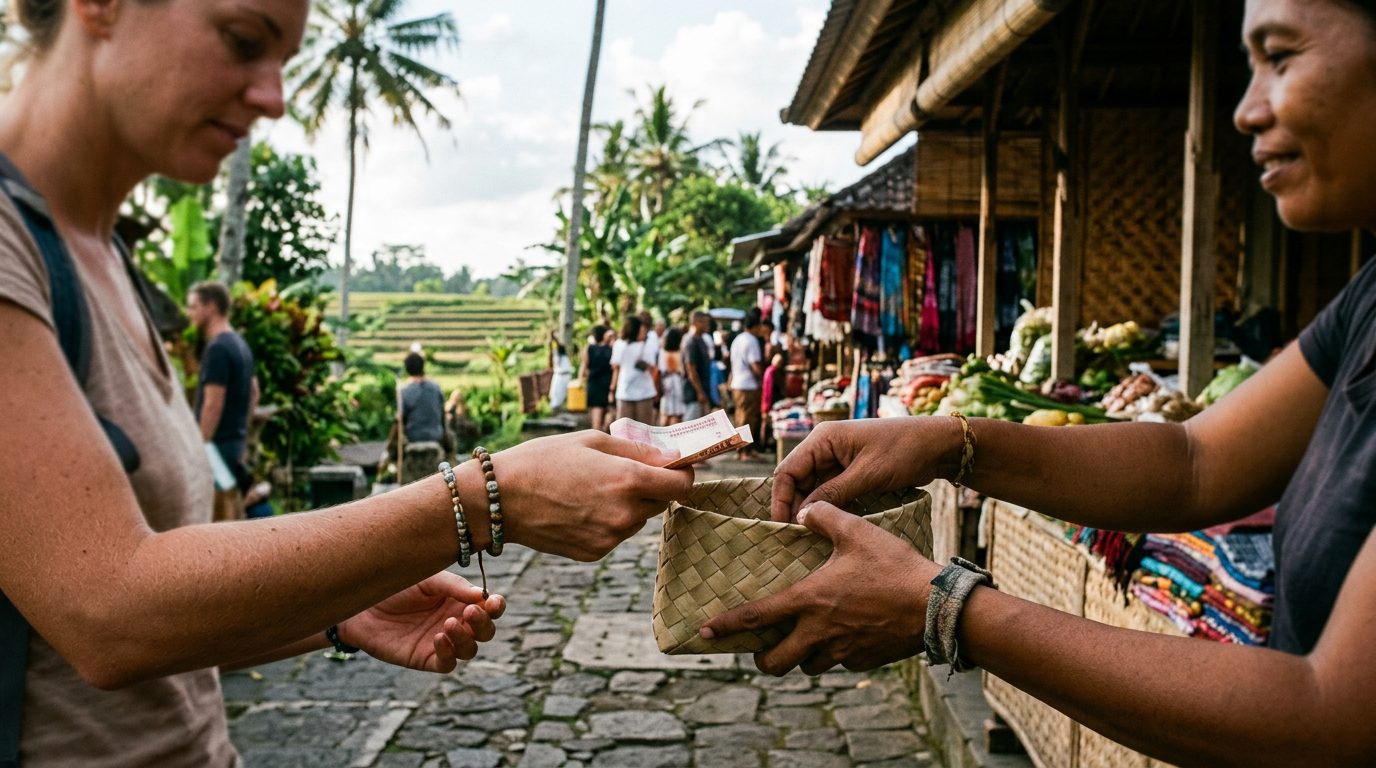
Cash is essential for small shops, local food stalls, market purchases, tips and short taxi rides where card machines are not present. Bring a mix of denominations with several 100,000 and 50,000 notes for convenience.
Cards are best for hotels, villa bookings, fine dining and larger activities because they offer easier receipts and security. Use one primary card for big expenses and keep a backup card stored separately in case of loss or ATM (automated teller machine) issues. Digital payments are growing in popularity for ride apps, food delivery and QR (quick response) payments, but acceptance varies outside major towns so treat them as useful extras rather than the main plan.
- Budget traveler: carry IDR (Indonesian rupiah) 1,500,000 about USD (US dollars) 100 in cash plus one card. This covers daily meals, cheap transport and small entry fees while using a card for accommodation when possible.
- Mid range traveler: carry IDR (Indonesian rupiah) 3,500,000 about USD (US dollars) 230 in cash plus two cards and a small digital balance of IDR (Indonesian rupiah) 200,000 to 400,000. This mix handles restaurants, private drivers, day tours and market shopping without constant ATM visits.
- Comfort traveler: carry IDR (Indonesian rupiah) 6,000,000 about USD (US dollars) 390 in cash with two cards and a digital balance around IDR (Indonesian rupiah) 500,000. This covers beach clubs, spas, private transfers and spontaneous purchases where card machines may not be available.
Split your cash between a hotel safe and a daily carry pouch and check card withdrawal limits before you travel. Prepay large items when possible and keep a modest cash reserve for unexpected local expenses. Next, learn where to get cash and how to secure the best exchange rate so you make the most of your money.
Where to get cash and how to secure the best exchange rate
For reliable cash access use ATMs (automated teller machines) at major bank branches in towns and malls rather than standalone machines on the street. Machines inside bank lobbies are refilled frequently and have a lower risk of skimming. Plan withdrawals in larger amounts to reduce repeated fixed fees—for example take IDR (Indonesian rupiah) 1,000,000 to 2,000,000 per withdrawal depending on your planned cash needs. Authorised money changers with a visible rate board and a printed receipt are a good choice for smaller exchanges and for denominations you need for market purchases. Avoid informal street changers and any offer to count notes in a crowd. Before you travel tell your bank which countries you will visit and note your ATM (automated teller machine) daily limit so you are not stuck without cash. Keep one backup card separate from your main wallet and store excess cash in a hotel safe, carrying only what you need for the day.
To secure the best exchange rate compare the posted rate to the mid-market rate on your phone and do the arithmetic on the spot to see the actual spread. When using a card always decline conversion into your home currency and opt to pay in IDR (Indonesian rupiah) to avoid dynamic conversion fees. Ask money changers if they charge commission and factor that into the effective rate. If you expect lots of small purchases, break some large notes into 50,000 and 20,000 denominations so vendors can give exact change. Finally, keep all receipts and count new notes before walking away to avoid disputes, and if you have leftover rupiah exchange at an authorised counter on departure to get the best return. With cash access and exchange sorted, follow a few safety habits to protect your funds while you travel.
Safety tips for cash, avoiding money scams and tipping etiquette
Keep your cash strategy simple and discreet to enjoy Bali with confidence. Carry only the day amount you need and store the rest in a locked hotel safe or secure luggage. Use a slim money belt or a concealed zip pocket when you are out and about. Split your funds across a main wallet and a small emergency stash kept separately so a single loss does not leave you stranded.
When withdrawing cash use ATMs (automated teller machines) located inside bank branches or in major malls and avoid standalone street machines. Cover the keypad when entering your PIN and check the machine for loose panels or attachments before you insert your card. Make larger withdrawals to reduce multiple fixed fees but do not carry excessive sums in public. Inform your bank of travel dates to prevent card blocks and keep a backup card in a separate place from your main card.
Avoid common scams by staying alert in crowded places and at market stalls. Count new notes before you walk away and ask for a printed receipt when changing larger amounts. Do not accept offers from spontaneous street money changers and refuse to be distracted while someone counts cash. For transport agree a price or insist on the meter before you board and keep small notes ready to prevent incorrect change claims.
Tipping is appreciated but not mandatory and a few small gestures go a long way. For restaurants check for a service charge first, then leave 5 percent to 10 percent in cash for good service or simply round up the bill. For drivers or day guides, 50,000 to 100,000 IDR (Indonesian rupiah) is a thoughtful tip for a full day. For housekeeping and porters, 10,000 to 20,000 IDR (Indonesian rupiah) per day is customary. Hand tips discreetly and thank staff politely to reflect local manners and ensure your generosity is well received.
If you want a convenient place to book accommodation with clear payment options and local support, consider browsing https://www.balivillahub.com/en for villa listings and booking details. Safe travels and enjoy your week in Bali with the right mix of cash, cards and common-sense precautions.