Comparing Living Costs in Bali and Jakarta for 2025
Bali Villa Hub
2/27/2026
Comparing Living Costs in Bali and Jakarta for 2025
Deciding whether Bali or Jakarta is cheaper to live in depends on the lifestyle you want, the housing you choose, and how you earn your income. This guide lays out the main cost differences so you can compare realistically. Amounts are shown in IDR (Indonesian Rupiah) and USD (United States Dollar) for reference, and the figures reflect typical 2025 market conditions.
Housing costs and rental market differences
Your choice of city strongly influences housing expenses. Jakarta generally offers predictable monthly rents in high‑rise apartments near business districts, while Bali spans from low‑cost village homes to luxury private villas with pools, creating a much wider price range.
Understanding typical price points and leasing conventions helps you budget accurately and avoid surprises when you arrive or renew a contract.
- Typical rent in central Jakarta — Most modern one‑bedroom apartments in areas like Sudirman or Kuningan rent for about 10 million IDR per month, roughly 650 USD, and often include building security and maintenance.
- Typical rent in popular Bali areas — A one‑bedroom private villa in Canggu commonly rents for around 8 million IDR per month, roughly 520 USD, while a three‑bedroom villa in Seminyak with a private pool can list at about 35 million IDR per month, roughly 2,300 USD.
- Short‑term versus long‑term dynamics — Bali short‑stay rates rise substantially during peak tourist months, so weekly bookings can be twice the long‑term monthly rate; Jakarta rents tend to remain stable year‑round.
- Deposit and agent fees — Long‑term Bali landlords typically ask for one month’s deposit, while Jakarta landlords frequently request two months’ deposit plus a one‑month agent fee for market listings.
- Utilities and extras — Jakarta serviced apartments often include water and internet, whereas Bali villas usually charge utilities separately and may require bottled water or refill systems.
When planning a move, choose the housing style that matches your lifestyle and work needs, and get clear terms in writing. Negotiate a defined list of inclusions to lock monthly cost and deposit terms before payment; this reduces risk and keeps your housing budget predictable.
With housing differences in mind, the next major cost area to consider is daily food and grocery spending, which we compare below.
Food and grocery expenses compared
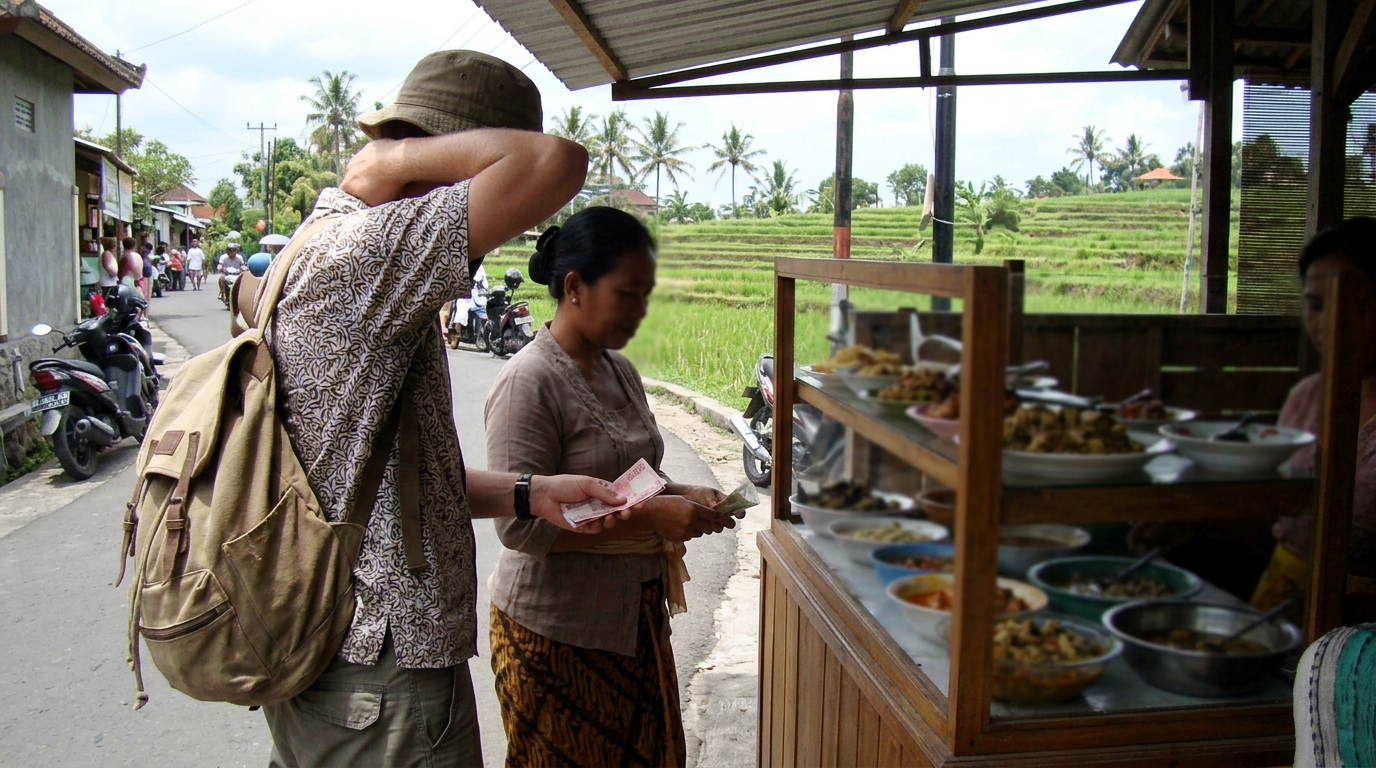
Food spending is one of the clearest differences between Bali and Jakarta. Eating out at a local warung typically costs about 20,000 to 35,000 IDR per meal in both cities, roughly 1.2 to 2.3 USD. A mid‑range restaurant meal in Jakarta commonly runs 80,000 to 150,000 IDR, while similar venues in tourist‑focused Bali areas often range from 90,000 to 200,000 IDR depending on location and concept. Coffee in a café usually costs 30,000 to 50,000 IDR in Jakarta and 35,000 to 60,000 IDR in Bali.
Grocery staples follow consistent patterns: a 5 kilogram bag of local rice costs about 70,000 IDR; a dozen eggs is around 24,000 to 28,000 IDR; chicken breast sells for 40,000 to 55,000 IDR per kilogram; local beef is 120,000 to 180,000 IDR per kilogram. Milk and other imported dairy items are pricier, with a litre of milk around 20,000 to 30,000 IDR. Expect imported items such as cheeses and specialty products to be about 30 percent more expensive in Bali compared with Jakarta.
Typical monthly budgets depend on habits: a single person who cooks most meals and buys local produce can expect approximately 1,500,000 IDR per month in Bali and about 2,200,000 IDR per month in Jakarta. If you dine out frequently and prefer imported groceries, add 1,000,000 to 2,000,000 IDR to those figures. Families will scale up proportionally based on children and dietary preferences.
To keep costs down, shop at pasar for fresh produce, buy staples in bulk, and cook at home where possible. If you want accommodation with a full kitchen or close market access, look for listings that prioritize those features.
Having covered food, we next examine utilities and transport, which can significantly affect monthly spending based on property type and commuting needs.
Utilities and transport expenses side by side
Utilities and transport often determine whether living costs feel light or heavy. Both Bali and Jakarta present trade‑offs: Jakarta typically offers lower basic utility costs for compact apartments, while Bali can have higher bills for standalone villas and longer travel distances in tourist zones.
Comparing electricity water and internet
Electricity costs depend heavily on size and air‑conditioning use. A small Jakarta apartment with limited aircon use typically has a monthly bill between 200,000 and 600,000 IDR. A three‑bedroom villa in Bali with continuous aircon and a pool pump commonly incurs bills from 1,200,000 up to 3,500,000 IDR per month. Municipal water in Jakarta is inexpensive when metered, but many residents rely on refill bottles that add around 30,000 to 80,000 IDR per refill. In Bali, properties that use well water or tank deliveries often see monthly water costs from 150,000 to 600,000 IDR depending on usage. Home internet pricing is similar in both cities, with a decent fiber plan costing around 300,000 to 600,000 IDR in Jakarta and roughly 350,000 to 700,000 IDR in Bali’s tourist areas.
Transport expenses and commuting realities
Fuel and vehicle costs are comparable per litre, but total spending differs by distance and mode. Scooter owners spend about 200,000 to 450,000 IDR per month on fuel in either city. Scooter rental in Bali ranges from 700,000 to 1,200,000 IDR per month, while long‑term scooter leases in Jakarta are often slightly cheaper. Ride‑hailing short trips in Jakarta commonly cost between 15,000 and 40,000 IDR, keeping daily commute costs predictable. In Bali, airport transfers and tourist routes can push single journeys into the 150,000 to 400,000 IDR range.
Practical budgeting tips
Build your monthly estimate around realistic, worst‑case usage. For a single person expect combined utilities and transport of approximately 800,000 to 2,500,000 IDR in Jakarta and 2,000,000 to 6,000,000 IDR in Bali when living in villa style. To control costs choose properties with utilities included, negotiate a clear utility cap, or opt for a compact apartment close to work. Filtering listings by utility inclusions and commute times can prevent unexpected bills.
Careful comparison of contract inclusions and realistic travel needs will make the true monthly cost clear and keep surprises to a minimum.
Next, consider healthcare and insurance costs, which can be significant—especially if you rely on private services or require medical evacuation options.
Healthcare and insurance cost comparison
Access to medical care differs between Bali and Jakarta in ways that affect your wallet. Jakarta hosts larger tertiary hospitals with a wide range of specialists and advanced diagnostics, which usually translates to slightly higher fees but faster access for complex treatment. A general practitioner visit in a private clinic typically costs 200,000 to 400,000 IDR, while a specialist consultation can range from 400,000 to 1,200,000 IDR. A private hospital single overnight stay for routine care often costs between 1,200,000 and 4,000,000 IDR per night depending on facility and room class. Bali offers competent private hospitals in Denpasar and private clinics in tourist areas, but for major surgery or specialised care many choose to travel to Jakarta. Emergency ambulance or medical transfer services can add 300,000 to 5,000,000 IDR when transport or air transfer is required, so factor that into contingency planning.
Insurance choices are a major cost driver. Most foreigners are not eligible for national coverage and rely on private local plans or international policies. Expect an international comprehensive policy for a healthy adult in their 30s to cost roughly 800 to 2,200 USD per year, depending on limits and inclusion of medical evacuation and repatriation. Family cover can be 4,000 to 12,000 USD annually. Out‑of‑pocket expenses matter too: routine dental fillings may be 300,000 to 900,000 IDR, while a private caesarean can cost 40,000,000 to 120,000,000 IDR. When choosing where to live, weigh proximity to quality clinics, confirmed direct‑billing arrangements, and clear evacuation coverage.
If access to reputable healthcare is a priority when choosing a property, factor that into your housing search and consider locations close to hospitals or clinics to reduce risk and transfer costs.
Finally, salary levels and local prices together define purchasing power; the section below summarizes typical pay bands and the impact on real income.
Comparing purchasing power and salaries in 2025
Salary levels and local prices together define real purchasing power in Bali and Jakarta. In 2025 Jakarta continues to offer higher nominal wages in formal sectors while Bali shows stronger local price inflation in prime tourist areas. The differences matter most when you move beyond basic needs into housing, leisure, and savings.
Average local salaries and sector differences
Entry‑level roles in Jakarta, such as administrative assistants or junior sales, typically earn between 4,000,000 and 7,000,000 IDR per month. Similar entry roles in Bali tied to tourism pay about 3,000,000 to 6,000,000 IDR. Mid‑level professionals in Jakarta frequently earn 12,000,000 to 25,000,000 IDR, while comparable mid‑level posts in Bali range from 8,000,000 to 15,000,000 IDR. Senior specialists and managers in Jakarta often exceed 35,000,000 IDR per month, a band seen less often in Bali unless the role targets international markets.
Expat pay and real buying power
Foreign‑currency pay changes the picture. An expat receiving 2,000 to 3,500 USD per month will enjoy substantial purchasing power in both cities, but housing choice shifts the outcome. Renting a private villa in Bali typically reduces disposable income by roughly 30 percent compared with a serviced apartment in Jakarta. For remote workers paid in dollars, the local cost advantage shows up in dining, transport, and services, while Bali tourist premiums raise prices for accommodation and imported goods.
Concrete salary scenarios to guide decisions
A local software engineer on 20,000,000 IDR monthly in Jakarta can cover a comfortable one‑bedroom apartment in a central district, pay utilities and commute, and still save. The same nominal pay in Bali will stretch further for daily spending but will falter if you choose high‑end villa living where housing can demand two‑thirds of that income. A practical rule of thumb is to budget 30 to 40 percent of net pay for housing in Jakarta and 40 to 60 percent in Bali when selecting private villa options.
Compare offers in terms of net pay, expected housing cost, and lifestyle priorities before deciding. If you want to match realistic housing budgets to salary scenarios, explore available listings and filters to see what fits your target spend.
For assistance finding properties that align with your budget, healthcare access, and commute needs, consider browsing listings at https://www.balivillahub.com/en to filter long‑term options by price, location, and included utilities.
Weigh the trade‑offs across housing, food, utilities, healthcare, and expected income. With clear priorities and realistic budgeting, you can choose the city and housing style that best fits your 2025 lifestyle and financial goals.