What are the cons of a villa in Bali?
Bali Villa Hub
3/8/2026
What are the cons of a villa in Bali?
Buying a villa in Bali can offer an attractive lifestyle and investment opportunity, but it also brings specific risks and ongoing commitments that are easy to underestimate. This article outlines the principal downsides—operational, financial, legal and practical—so you can make a balanced decision and plan appropriately before you buy.
Disadvantages of owning a villa in Bali
Owning a villa in Bali can be a wonderful lifestyle choice and an attractive investment, but there are clear downsides to consider. Below are the most common practical challenges owners face that can erode returns and add stress if not planned for properly.
Running costs and unexpected repairs
Routine servicing for a three-bedroom villa with a swimming pool typically includes weekly pool cleaning at around IDR 100,000 per visit and garden maintenance twice a week at IDR 40,000 per visit. Employing two full-time local staff commonly costs about IDR 3,000,000 per person each month. When you add utilities, internet and basic consumables, the realistic annual running cost for this profile often equals about IDR 50,000,000.
Major repairs are more costly. Roof replacement, termite treatment or significant plumbing work can each run into tens of millions of rupiah and often occur without much notice. Owners need an emergency reserve and a reliable contractor network to respond quickly and control costs.
Legal status and ownership limits
Foreign buyers cannot usually hold freehold title in their own name. The most common legal path is a lease agreement that begins at 25 years with negotiated renewal options. Alternative structures such as setting up a local entity require careful legal and tax planning and can add complexity to future sale or inheritance.
Choosing the wrong structure without proper local legal advice exposes owners to transfer difficulties and possible extra costs when transferring use rights or exiting the investment.
Understanding these operational and legal downsides leads naturally to a closer look at the direct costs and tax obligations you should expect.
Costs and tax obligations you must expect
When budgeting for a Bali villa purchase you must account for clear one-off costs and predictable recurring charges. Understanding the names and typical sizes of these obligations prevents nasty surprises during transfer and in the first year of ownership.
Below are the specific items most buyers face and realistic figures to use when planning your cash needs.
- BPHTB (Bea Perolehan Hak atas Tanah dan Bangunan) — this acquisition duty commonly equals 5 percent of the transaction value; notary or deed preparation usually adds one to two percent of the sale price as professional fees.
- VAT (value added tax) and developer levies — new builds from developers may include an 11 percent VAT on the construction or sale component plus administrative charges that vary by project.
- PBB (Pajak Bumi dan Bangunan) — ongoing property tax is typically modest and charged against assessed value; plan a few million rupiah per year depending on location and land size.
- Income tax and withholding rules — rental income is taxable. Nonresidents commonly face a final withholding at around 20 percent while resident companies pay corporate tax on profits at roughly 22 percent and resident individuals pay progressive rates.
- Operating costs and reserves — expect monthly outgoings for staff, cleaning and security, utilities and pool maintenance that commonly total IDR 6,000,000 to IDR 15,000,000 for a standard three-bedroom villa, plus an emergency reserve for major repairs.
Factor these costs into your purchase offer and cash-flow model rather than treating them as afterthoughts. Engage a local accountant early to confirm current rates and to structure ownership in a tax-efficient and compliant way.
With taxes and fees mapped out, the next practical area to consider is the specific legal hurdles that affect foreign buyers.
Legal hurdles and foreign ownership complications
Foreign buyers face clear legal limits when acquiring land and villas in Indonesia. The most important reality is that Hak Milik, or freehold title, is reserved for Indonesian nationals. That means typical foreign ownership options are long-term lease agreements, Hak Pakai use rights, or holding property through a locally registered company such as PT PMA (Perseroan Terbatas Penanaman Modal Asing) when the intention is commercial use. Relying on informal nominee arrangements creates real legal risk and is not a safe substitute for a properly documented structure.
Each title has practical constraints and timing implications. Hak Pakai is commonly granted for periods around 25 years and requires formal registration. Hak Guna Bangunan is issued for building rights and is usually granted for 30 years subject to renewal by the land office. Lease agreements must be precisely drafted and registered with the national land agency to be enforceable. If a villa lacks an IMB (Izin Mendirikan Bangunan) building permit or has unclear setbacks and zoning, authorities can require costly remediation or even removal of structures.
Transactions demand rigorous due diligence. Verify the original land certificate and seller identity at the land office, check for encumbrances and outstanding tax obligations, confirm the IMB for every building, and use an Indonesian notary to prepare the sale deed and register transfers. Expect the process from signed agreement to completed registration to take several weeks up to three months depending on complexity. Notary and legal fees typically range from one percent to two percent of the sale price plus variable administrative charges.
Mitigate risk by engaging a reputable local lawyer and a licensed notary early, insisting on registered leases or corporate ownership where appropriate, and budgeting a specific legal reserve. Strong documentation and a clear exit plan convert legal complications from a threat into a manageable part of villa ownership.
Beyond legal and tax matters, Bali’s climate introduces its own set of maintenance challenges you must plan for.
Maintenance challenges and climate related damage
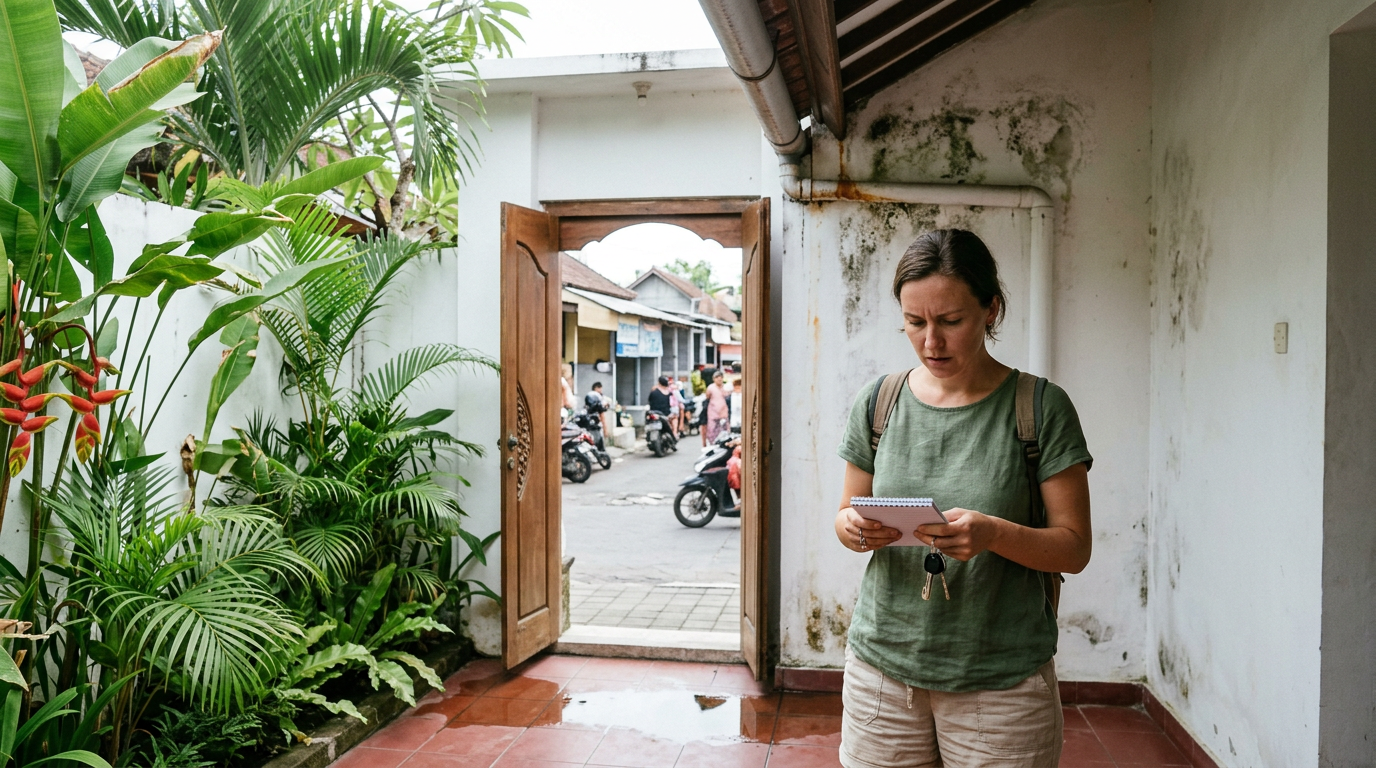
Bali’s tropical environment places continuous stress on villa fabric and systems. High humidity and months of heavy rain encourage mold growth and timber rot while coastal salt air accelerates metal corrosion on railings, gates and external fixtures. Intense sun leads to UV degradation of outdoor paints and pool liners, while monsoon months (November through March) produce sudden downpours that test gutters and drainage. Typical repair figures to keep in mind include roof tile replacement at IDR 5,000,000 to IDR 20,000,000 depending on scope, full-house termite eradication between IDR 3,000,000 and IDR 12,000,000, and major electrical rewiring in corrosive locations at IDR 15,000,000 to IDR 50,000,000. Pools often need pump replacement or replastering every five to ten years at a cost commonly from IDR 8,000,000 to IDR 25,000,000.
Practical mitigation turns these risks into predictable costs rather than surprises. Specify stainless steel 316 fittings for coastal properties, use treated hardwoods or composite decking, and insist on membrane waterproofing under tiled roofs and wet areas. Schedule weekly pool service at roughly IDR 100,000 per visit and monthly gutter and roof checks at around IDR 150,000 to prevent blockages. Quarterly pest control treatments at about IDR 500,000 reduce termite exposure. For budgeting, set a maintenance reserve of IDR 50,000,000 per year for a standard three-bedroom villa inland and add IDR 30,000,000 to IDR 60,000,000 extra for a coastal location, plus a long-term contingency fund of IDR 100,000,000 for major work across a five-year horizon. Regular inspections, trusted local contractors and these specific allowances are the most effective way to protect value and minimize downtime.
Finally, even with costs and maintenance planned, buying and managing a villa requires time and careful due diligence.
Time management and due diligence burdens
Buying a villa in Bali demands both significant time and disciplined due diligence to avoid costly mistakes. Expect a structured checklist that includes verifying the original land certificate at the land office, confirming absence of encumbrances, checking the IMB permit for every building, obtaining a recent PBB tax receipt, and confirming the seller identity with national ID documents. Add technical inspections such as a structural survey and termite report to identify hidden defects. Typical fees to budget are surveyor costs from IDR 5,000,000 to IDR 15,000,000, geotechnical testing from IDR 10,000,000 to IDR 25,000,000 for undulating sites, and structural inspections from IDR 3,000,000 to IDR 12,000,000 depending on scope. Administrative and legal steps take time as well. Notary preparation and registration commonly add one to two percent of the sale price in fees and paperwork processing will usually span four to twelve weeks. Remote buyers must add travel time for at least one on-site visit during negotiation and one final check before completion. Managing contractors and staff requires weekly oversight for operations and monthly financial reconciliation to catch small issues before they escalate. If you cannot be present, appoint a trusted property manager and allocate a management budget of IDR 5,000,000 to IDR 12,000,000 per month or a percentage of rental revenue to ensure timely maintenance and bookings. A practical timeline reduces risk by sequencing checks in parallel where possible and holding 10 percent of the purchase price in escrow until key permits and clearances are confirmed. Treat due diligence as non-negotiable and schedule fixed milestones for document review, technical inspections and registration; that approach turns what feels like a burdensome time commitment into a controllable process that protects capital and preserves the villa as a long-term asset.
Conclusion: Villa ownership in Bali can deliver lifestyle and financial benefits, but only with realistic budgeting, legal clarity, proactive maintenance and disciplined oversight. If you would like practical local support to assess properties, run checks, or explore listed options, visit https://www.balivillahub.com/en for helpful guidance and listings from local experts.