Who is the owner of Bali, Indonesia?
Bali Villa Hub
3/25/2026
Who is the owner of Bali, Indonesia?
Bali is often described in personal terms—owned by families, developers or foreign investors—but in reality ownership and authority on the island are complex and layered. This article outlines who has historically exercised power in Bali, how political control operates today, the legal limits on land held by foreigners, the forces driving the island’s real estate boom, and how customary land rights shape community ownership. Understanding these overlapping systems clarifies why no single person or entity can be said to "own" Bali in whole.
Monarchs and traditional rulers of Bali
Bali's political history is shaped by a succession of monarchs and local rulers whose authority mixed temporal power with sacred obligation. These leaders guided ritual life and managed relations between competing courts long before modern administration took hold. That historical legacy still informs contemporary identities and local respect for certain families and palace institutions.
Ancient dynasties and early kingdoms
From inscriptions of the Warmadewa line to the rise of Gelgel, early Balinese rulers established regional courts that exercised both political control and temple stewardship. The arrival of Majapahit influence in the fourteenth century reshaped court structures and introduced new royal titles that echoed across the island.
Principalities and palace courts
By the seventeenth and eighteenth centuries Bali was divided among several rajas who ruled principalities such as Mengwi, Tabanan, Buleleng and Karangasem. Each court maintained its own palace rituals, military units and land networks. Families such as the Sukawati in Gianyar and the Pamecutan line in Badung produced rulers who balanced warfare with alliance building and patronage of the arts.
Ritual authority and transition to modern rule
Traditional rulers derived legitimacy from ritual enactment and control over temple lands. Even as colonial pressure eroded direct sovereignty, many rajas retained cultural authority and managed adat or customary law in their regions. After integration into the Indonesian state their roles became largely ceremonial yet remain central to community identity and festival life.
Understanding Bali's monarchs means seeing power as woven with religion and custom. Today former royal houses act as custodians of heritage, and their palaces and ceremonies continue to shape local society and the island's cultural landscape. This historical context provides a bridge to how modern governance was layered on top of longstanding customary systems.
Modern government and political control in Bali
Administratively, Bali is a province within the Republic of Indonesia and governed through a layered system that blends formal state institutions with resilient local customs. Political authority is exercised at provincial and regency levels while customary practices continue to shape daily governance and community decision making across the island.
Provincial and local administrative structure
The province is led by an elected governor and vice governor supported by a provincial legislature. Below the province are eight regencies and one city, each led by an elected regent or mayor and a local council. Administrative units such as districts and villages manage public services and civil registration, and are responsible for implementing provincial and national policies on health, education and infrastructure.
Electoral politics and party influence
Local and regional elections determine much of Bali's political leadership. Political parties compete at every level and coalition building is common in regency councils. Governors and regents have significant budgets and discretion, which makes local elections highly contested. National party dynamics often influence appointments and development priorities, especially where tourism and investment are at stake.
Adat institutions and state relations
Customary institutions remain a parallel source of authority. Banjar councils and traditional elders regulate matters from temple ceremonies to communal land use, and adat decisions carry social weight even when they do not have formal legal force. The state frequently negotiates with adat leaders to implement programs that affect communal resources, creating a hybrid governance space where formal regulation and customary practice intersect.
In practice, political control in Bali is the result of constant negotiation between elected officials, central government directives and customary authorities. That balance shapes policy outcomes and helps explain why local identity and ritual life remain central to governance on the island. These governance realities also influence how land is owned and managed, which is the focus of the next section.
Land ownership rules and limits for foreign buyers
Foreigners are subject to strict limitations when acquiring land in Indonesia and Bali is no exception. The legal framework aims to protect national land rights, so buyers must plan transactions around specific titles and recognised legal structures.
Key practical options include long term leases, rights granted to foreign investment companies and the hak pakai right available to certain foreign nationals. Each option carries distinct time limits and registration requirements that determine control and transferability.
- No freehold for foreigners. Only Indonesian citizens may hold hak milik or full freehold ownership, so foreign buyers cannot register land as freehold in their personal name.
- Right to use for individuals. Hak pakai is the primary title available to foreign individuals and is typically issued for an initial period of 25 years and can be extended subject to government approval.
- Corporate route through a PMA (foreign-owned limited liability company). A foreign-owned limited liability company registered as a PMA can obtain hak guna bangunan for development projects, commonly issued for a period of 30 years and renewable under prevailing regulations.
- Long term lease contracts. Many transactions use leases ranging from 20 to 99 years with clear renewal clauses and registration at the Land Office to secure the lessee position against third parties.
- Restrictions on certain land types. Protected zones, agricultural paddy, traditional temple grounds and areas reserved by local adat often cannot be transferred to non-local entities without complex permissions.
Buyers should secure certified title searches and register agreements with the National Land Agency to ensure enforceability. Nominee arrangements are illegal and expose parties to significant risk, so transparent structures are essential. When considering corporate or individual routes, confirm the exact terms of hak pakai or HGB (hak guna bangunan) grants to clarify duration, renewal mechanics and tax or development obligations before committing to purchase or lease.
Clear documentation and reputable local advisors reduce legal exposure and help align transactions with both statutory requirements and customary expectations. With that legal backdrop in mind, the next section looks at who is actually buying land in Bali and why.
Real estate boom and who is buying Bali's land
The past decade has seen a pronounced real estate boom concentrated in coastal and cultural hotspots such as Canggu, Seminyak and Ubud, where demand for short-stay accommodation and lifestyle living has pushed land values sharply higher. Buyers fall into clear categories: local developers and Indonesian corporate groups acquire large tracts to build resorts and apartment projects; high net worth domestic buyers and Balinese families expand holdings to capitalise on tourism-related income; and foreign interest comes primarily from Australia, China, Singapore, Russia and parts of Europe, with investors purchasing through foreign investment companies or long leases to secure usable rights. A significant share of transactions are driven by hospitality and villa operators creating boutique properties attractive to the short-term rental market and social media platforms that value photogenic locations and privacy.
The consequences are tangible on the ground, with conversions of irrigated rice land into villa compounds, clustering of gated developments and rising pressure on local infrastructure and water resources. Land in prime corridors often commands a premium, sometimes two to three times higher than comparable plots inland, and buyers accept limited tenure arrangements such as hak pakai or HGB through PMA companies or leases typically negotiated for 25 to 99 years. That premium and legal complexity have sparked disputes involving adat communities and municipal planners. For prospective buyers, certainty comes from documented title searches, transparent registered agreements and active engagement with village-level customary leaders to avoid social conflict. Observing local land use rules and respecting customary rights remains the most reliable way to secure long-term value while protecting community resilience.
Given these complexities, many prospective buyers and renters turn to trusted local platforms for listings and guidance. For property seekers wanting practical, locally informed options, visit https://www.balivillahub.com/en to explore current listings and get guidance on navigating Bali's real estate landscape.
Customary land rights and community ownership practices
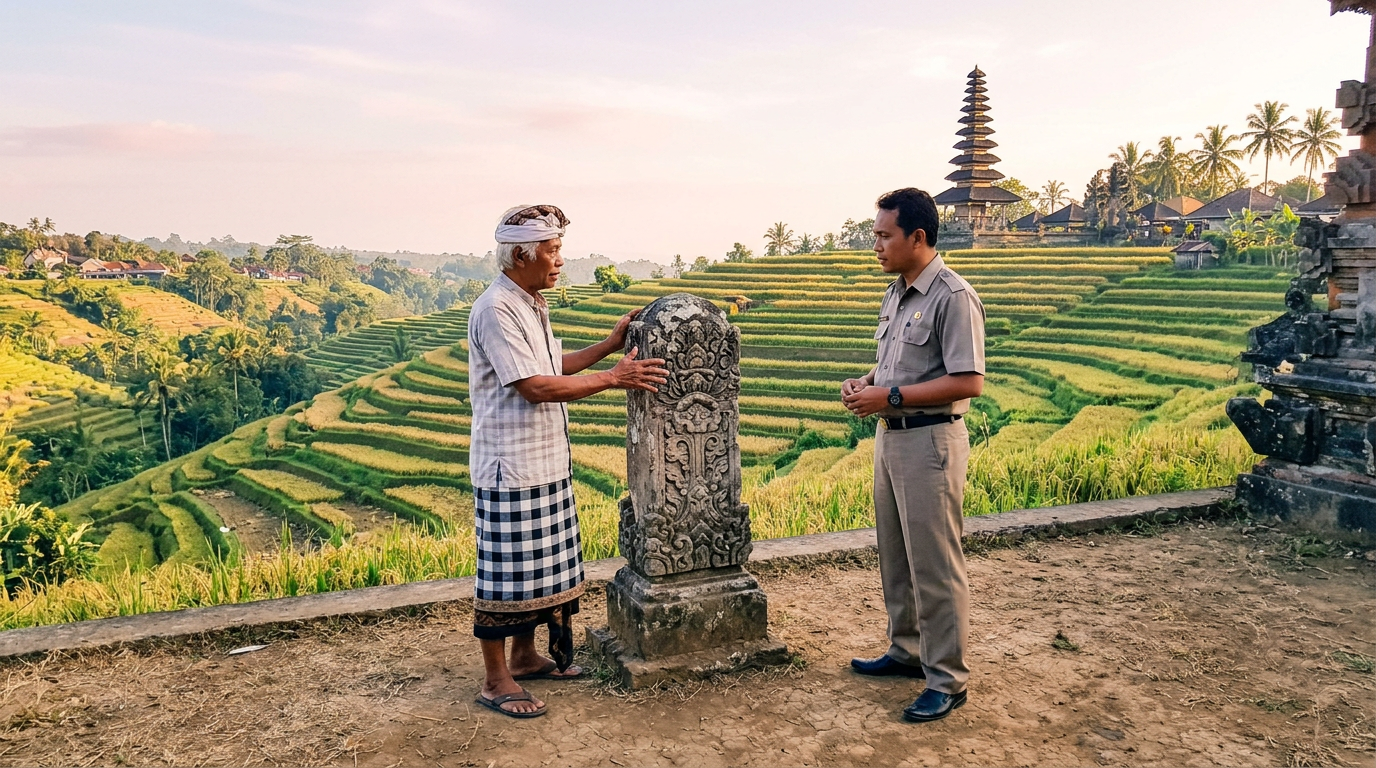
Customary land rights in Bali form a parallel system of ownership that predates modern titles and remains central to village life. These rights govern how rice paddies, temple grounds and communal resources are used and transferred, ensuring that land supports ritual obligations and collective welfare. Mapping customary claims against formal titles is essential before any transaction proceeds.
Desa adat institutions and customary governance
Desa adat and banjar councils are the principal bodies that manage customary land. They convene to decide allocation of ulayat land, resolve disputes and enforce adat rules through locally accepted sanctions that preserve social harmony.
Subak irrigation cooperatives operate alongside these institutions to regulate water access and planting schedules. Subak management is based on shared rules and coordinated labor that secure productive terraced agriculture and help maintain long-term ecological balance.
- Ulayat land and communal agriculture. Ulayat land is held for the benefit of the entire village and cannot be sold without collective consent, which limits individual alienation and supports shared food security.
- Temple and cemetery grounds. Land reserved for temples and ancestral cemeteries remains under customary stewardship and is protected from commercial conversion to maintain ritual continuity.
- Pekarangan and family use rights. House compounds and garden plots are often allocated by adat with inheritance rules that prioritise family continuity while still recognizing village obligations.
For anyone engaging with Bali land matters it is essential to map formal titles against customary claims and seek approval from desa adat bodies. Respecting local procedures and documenting agreements with community leaders helps avoid conflict and aligns investment with the island's cultural fabric. Combining legal due diligence with community consultation offers the best path to responsible and enduring land use in Bali.